Lower Fees, No Chargebacks: Why Stablecoins Beat Card Payments
Back to articles
TL;DR
Card payments work, but every transaction passes through layers of intermediaries that each take a cut.
- Stablecoins are digital dollars that can be sent directly from customer to merchant without card networks or banks in between.
- Fewer intermediaries typically means lower fees, sometimes just pennies per transaction.
- Payments settle in seconds or minutes, not days. No batching, no weekends, no waiting.
- Once a stablecoin payment confirms, it's final. No chargebacks, no funds pulled back weeks later.
- You don't have to choose. Stablecoins can run alongside cards and cash where they make sense.
In the first post of this series, we looked at why card payments are so expensive for small businesses. The takeaway was simple: cards work, but the economics aren't designed in your favor. Fees scale with your revenue, not your costs. And the system isn't going to fix itself.
For the first time in years, there's a real alternative to card payments. Not a replacement. But a better option that cuts out the middlemen.
That option is stablecoins.
What is a Stablecoin?
A stablecoin is a digital token pegged to the U.S. dollar. In practice, that means:
- One unit is intended to equal about one dollar
- It lives on a blockchain instead of inside a bank ledger
- It can be sent directly from one wallet to another, at any time
It moves electronically, but it doesn't rely on card networks, issuing banks, or payment processors for each transaction. Think of it as digital cash. When a customer sends a stablecoin payment, dollars move from them to you without passing through the traditional card stack.
For a merchant, that difference matters. Instead of pulling funds through a chain of intermediaries that take a percentage at each step, the customer sends dollars straight to you. Closer to handing over cash than swiping a card.
Because the payment path is simpler, the cost structure is too. On many stablecoin-friendly networks, fees land at 1% or less, sometimes just a few cents for a typical retail transaction. Compared to card payments that often run 2.5% to 3.5% all-in, the math starts to look different. On a $100 sale, network fees might be as little as a few cents. Over a year of sales, that difference compounds in a way card fees never do.
Stablecoins Built for Payments


How Stablecoin Payments Work Differently
The differences go beyond fees. Stablecoin payments behave more like cash than cards in ways that matter for day-to-day operations.
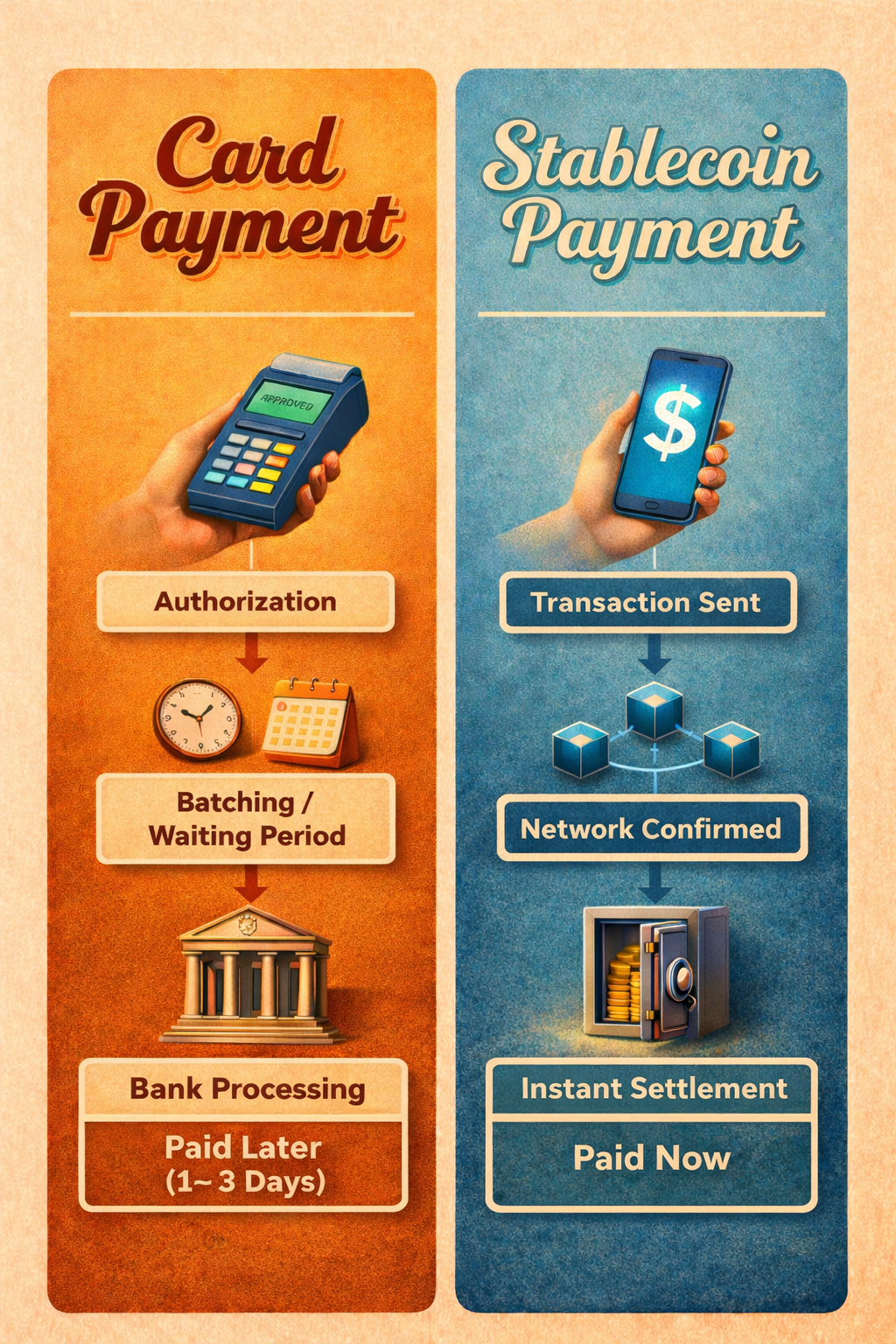
Settlement is faster. When a customer taps a card, the payment doesn't actually settle right away. It's authorized, batched, settled, and finally paid out, often one to three business days later. Stablecoin payments confirm in seconds or minutes. There's no batching window. Weekends and holidays don't slow things down. When the payment arrives in your wallet, it's already settled.
For a small business, that can mean:
- Faster access to funds to restock or pay suppliers
- Less reliance on short-term credit
- Fewer surprises from delayed payouts
- More control over cash flow
Transactions are final. With cards, a customer can initiate a chargeback weeks after a purchase. Funds get pulled back while you dig up receipts and documentation to dispute it. With stablecoins, once a transaction confirms on-chain, it's final. You can still offer refunds but refunds are initiated by you, not reversed automatically by a card network.
For many merchants, fewer chargebacks means:
- Less fraud exposure and administrative work
- Fewer moments wondering where the money went
None of this makes cards unusable. But slow settlement and chargeback risk are design choices, not laws of nature.
Why Stablecoins Are Worth Considering Now
If stablecoins are cheaper and settle faster, why aren't they everywhere already?

For a long time, they weren't ready. The technology was early, the user experience was rough, and the ecosystem was too small to matter for most merchants.
That's changing. Stablecoins aren't a niche experiment anymore:
- Stablecoin transaction volume now rivals Visa and approaches ACH, the electronic backbone of the U.S. banking system
- Visa, PayPal, Shopify, and Stripe have added stablecoin support
- The U.S. passed its first stablecoin regulatory framework (the GENIUS Act) in 2025
Stablecoins change the math on payments, but on their own they aren't a point-of-sale system. To work in the real world, they need to feel as simple and familiar as tapping a card. That's what Burner Terminal is for.
A new point of sale for stablecoin payments.

Final Thoughts
Card payments are convenient, but the fee structure was never built to favor small businesses. Processing fees often land between 2.5% and 3.5%, and they scale with your revenue, not your costs. For low-margin businesses, that can quietly consume a significant share of profit.
The good news is that the payments world is starting to get a second option. Stablecoins change the math, often reducing costs and removing many of the tradeoffs merchants have come to accept with cards.
FAQ: Stablecoins for Small Business Payments
❓ What is a stablecoin?
A stablecoin is a digital token pegged to the U.S. dollar. One unit is designed to equal about one dollar. It moves over blockchain networks instead of card rails, which means fewer intermediaries and lower fees.
❓ How do stablecoin fees compare to credit card fees?
Card payments typically cost 2.5% to 3.5% per transaction. Stablecoin payments on modern networks can cost 1% or less, sometimes just a few cents regardless of transaction size.
❓ How fast do stablecoin payments settle?
Seconds to minutes. There's no batching, no business-day delays, and no waiting for weekends or holidays to pass. When the payment arrives, it's already settled.
❓ Are stablecoin payments reversible?
No. Once a stablecoin transaction confirms on-chain, it's final. You can still issue refunds, but they're initiated by you, not reversed by a third party.
❓ Do I need to replace my current payment setup?
No. Stablecoins work best as an additional option alongside cards and cash. You don't have to choose one or the other.
❓ What stablecoins can I accept?
The most common are USDC (issued by Circle) and USDT (issued by Tether). Burner Terminal also supports USD II, a gasless stablecoin designed for merchant transactions.
❓ Is this legal and regulated?
Yes. The U.S. passed its first stablecoin regulatory framework (the GENIUS Act) in 2025, and major companies like Visa, PayPal, Stripe, and Shopify now support stablecoin payments.
Get your Burner
What to read next
Back to articles
Coldcard's $116M Hack: Why One Entropy Source Isn't Enough
Every security feature on a hardware wallet protects the key after it exists. The recent Coldcard hack, roughly $116 million drained from more than 5,200 addresses, shows what happens when the number behind that key came from one source and the source was wrong.

Who Is Satoshi Nakamoto? The Suspects and the 2026 Hunt to Unmask Bitcoin's Creator
More than 17 years after Bitcoin's first block, no one has proven who Satoshi Nakamoto is. We go through the leading suspects, the competing answers from a 2026 documentary and the New York Times, and what Satoshi's untouched coins say about holding bitcoin yourself.

What is a Real-World Asset (RWA)? A Guide to RWAs on Base and How to Securely Store Them
A real-world asset is something that exists off the blockchain, like a US Treasury bond, a money market fund, a bar of gold, or a share of stock, represented on-chain as a token. The token isn’t a new asset with value of its own. It’s a claim on the real one, recorded on a blockchain so it can be moved, split, and held the way you’d hold any cryptocurrency.